If you’re researching treatment in Florida for someone you love, you’ve probably run into the phrase “Florida model.” It gets used as a selling point, but most families have no idea what it actually describes. Before you choose a program based on a label, it helps to know what the Florida model is, where it came from, and why a residential mental health setting can be a better fit when the primary problem is psychiatric, not just substance use.
What Is the Florida Model of Treatment?
The Florida model separates the clinical side of treatment from where a person sleeps at night. Therapy, groups, and psychiatric appointments happen at a licensed clinical building during the day. Clients then go back to a separate recovery residence, often a shared apartment or house, for the evening. The two pieces are run as distinct components rather than one residential facility under a single roof.
This structure grew out of South Florida’s addiction-treatment industry in the 1980s and 1990s. It pairs daytime clinical care, usually billed as a partial hospitalization program (PHP) or intensive outpatient program (IOP), with sober-living housing on the side. For someone whose main need is a structured, peer-supported environment to practice early recovery skills, the arrangement can work. People cook, manage a budget, hold each other accountable, and ease back into daily life while still attending treatment hours.
Where the Florida Model Falls Short for Mental Illness
The split-housing setup was built for addiction recovery, and it assumes a person is stable enough to live semi-independently in a residence with limited overnight clinical staff. That assumption breaks down when the primary condition is a serious psychiatric illness.
Active suicidal ideation, psychotic features, severe mood episodes, and complex trauma don’t keep business hours. A person stabilizing on new medication needs close observation through the night, not a quiet apartment across town from the clinical team. Many addiction-focused programs will check a “dual diagnosis” box on their website, but they’re not staffed or licensed to treat severe mental illness as the main diagnosis. The mental health piece ends up bolted on rather than treated at full depth.
This is the gap a lot of families fall into. Someone gets discharged from a 72-hour hospital hold still unwell, then can’t get into a standard rehab because the program won’t accept active psychosis or suicidal ideation. The Florida model, with its separate sober-living residence, often isn’t the right level of care for that person either.
How Destination Hope’s On-Site Residential Model Differs
Destination Hope takes a different approach. It’s a residential mental health treatment center in Fort Lauderdale where clinical care and housing live under the same roof, not in two separate buildings across the city. Clients stay on-site, and the clinical team is present around the clock. That matters most during the hardest stretch of treatment, when stabilization and safety can’t wait for the next day’s appointment.
The model is psychiatrist-led and built on a clinical team at the Masters level and above, so the care doesn’t outrun the credentials of the people delivering it. Destination Hope treats psychiatric conditions as the primary diagnosis: depression, anxiety, bipolar disorder, PTSD, psychotic and thought disorders, and complex trauma. When a substance use disorder is present alongside the mental illness, it’s treated fully and at the same time through integrated dual diagnosis care, never as an afterthought.
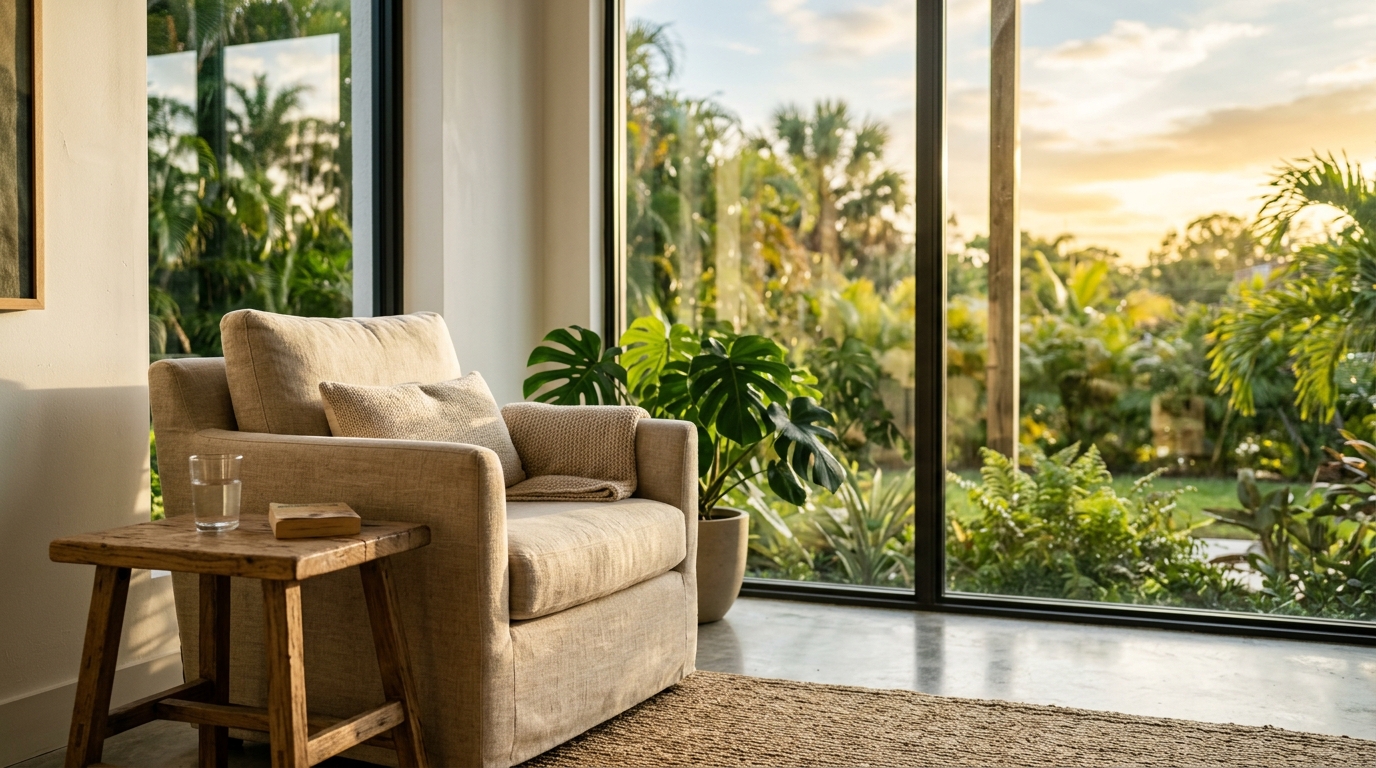
The center has been Joint Commission accredited since 2006 and is licensed by Florida’s Department of Children and Families and the Agency for Health Care Administration. Care runs as a full continuum: on-site medical detox when it’s needed, gender-specific residential treatment, then PHP, IOP, and extended care as step-downs. You can see how each stage connects on the levels of care page. The residence is bright and comfortable. It isn’t a hospital ward, and it isn’t a resort. It’s an environment built for serious clinical work.
Choosing the Right Setting for Your Situation
A separate sober-living residence can suit someone whose recovery is already stabilizing and who mainly needs structure and peer support. When the harder need is psychiatric, an on-site residential program with overnight clinical staffing usually fits better. The right question isn’t which label sounds best. It’s which level of care matches what the person in front of you actually needs right now.
If you’re not sure where your loved one falls, that’s exactly the conversation our team has every day. Reach out through Destination Hope admissions or call (954) 302-4269 to talk through the situation and figure out the right starting point.
Crisis and Emergency Resources
If you or someone you know is in a substance use or mental health crisis, help is available now. Contact the SAMHSA National Helpline at 1-800-662-HELP (4357) for free, confidential treatment referrals 24/7. Reach the 988 Suicide and Crisis Lifeline by calling or texting 988. The Crisis Text Line is available by texting HOME to 741741. For emergencies, call 911.