

Life in South Florida is stressful, and unexpected mental health struggles can easily become a person’s breaking point. Maybe a full residential stay seems unrealistic, but weekly therapy won’t cut it. An intensive outpatient program (IOP) for mental health offers the best of both worlds. You get skilled clinical support by day and sleep in your own bed at night.
Sometimes mental health conditions require more than just occasional check-ins. At Destination Hope, we offer IOPs to help ensure that every individual has access to the tools they need for long-term recovery. Here’s what you should know.
What Is An Intensive Outpatient Program for Mental Health?
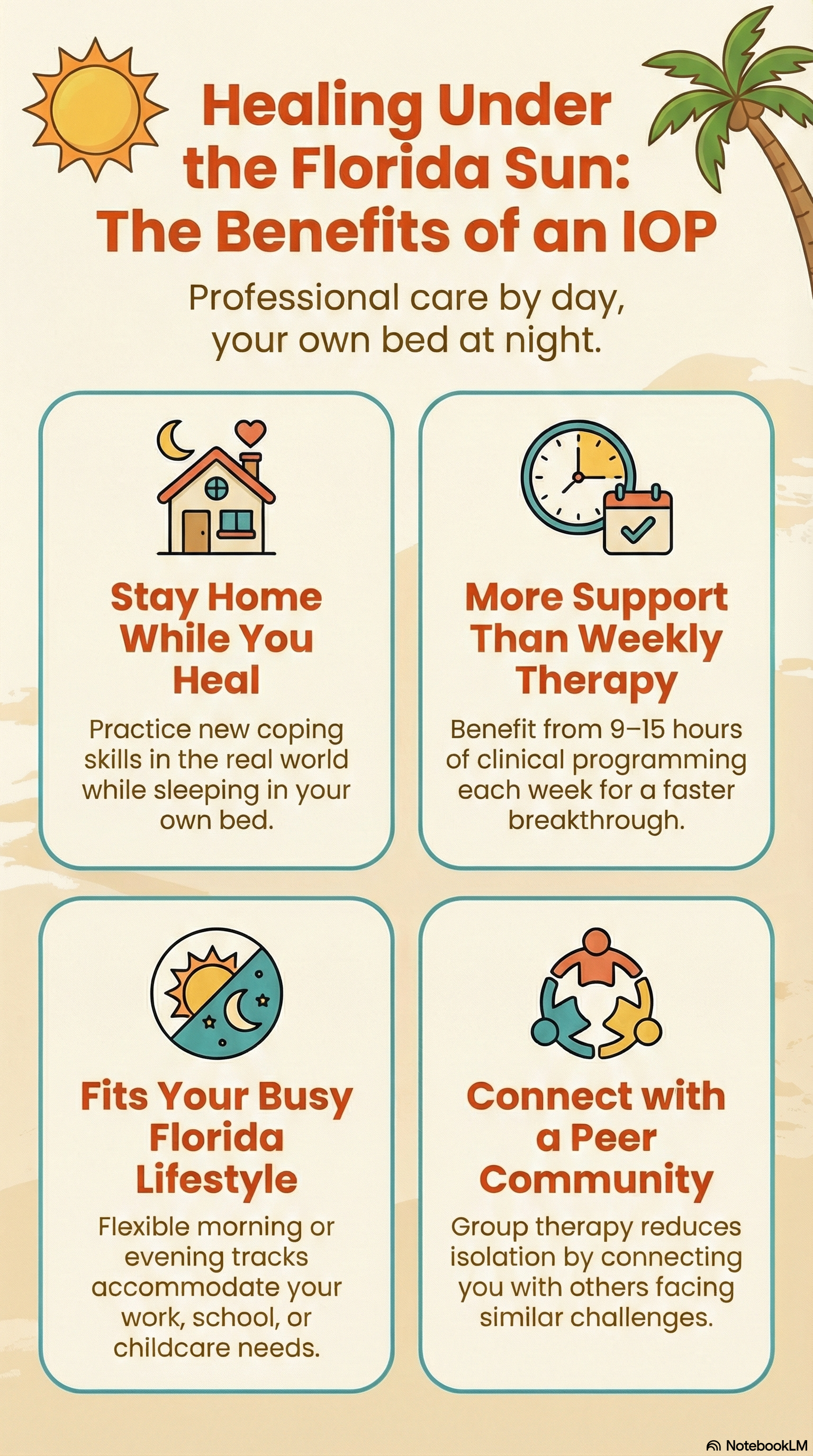
An intensive outpatient program for mental health is a structured treatment plan designed for those who are medically stable but still struggle with debilitating symptoms. In an IOP, clients get several hours of clinical programming multiple days a week.
The goal of this structure is to provide evidence-based interventions in a setting that encourages real-world application of coping skills. You stay in your own home to practice the strategies learned in therapy, making a transition into long-term wellness more sustainable.
How IOP Differs From Other Levels Of Care
Traditional outpatient therapy usually involves one hour of counseling per week. While helpful for maintenance, it often lacks the intensity needed for a breakthrough during a crisis. On the other end is residential treatment, where clients live at a facility for 30 days or longer to receive constant care.
A partial hospitalization program (PHP) sits between residential care and IOP. PHP typically requires five to seven days of treatment per week for six or more hours a day, essentially serving as a full-time commitment. An IOP is less time-intensive, offering a “step-down” level of care that maintains clinical rigor while freeing up time for school, work, or childcare.
Typical IOP Schedule And Structure
Most intensive outpatient programs for mental health involve nine to fifteen hours of clinical work per week. This is often divided into three-hour sessions conducted three to five days a week. Many South Florida mental health treatment centers offer morning or evening tracks to accommodate different professional schedules.
A typical session involves a mix of group therapy, individual counseling, and educational workshops. The structure is designed to be consistent and predictable, providing a sense of stability that is often missing when someone is struggling with a mental health disorder. This routine helps clients build a foundation for healthy habits that continue long after the program ends.
Who Benefits From Mental Health IOP?
An intensive outpatient program is particularly beneficial for individuals who have a supportive home environment but still need professional guidance. It serves as a resource for those in Miami-Dade and Broward County transitioning out of a hospital setting. It is also highly effective for people whose mental health has begun to interfere with their professional performance or academic success.
IOP is often the best fit for those who are motivated to change but feel overwhelmed by the prospect of traditional therapy alone. It provides a community of peers who are facing similar challenges, reducing the isolation that often accompanies mental health struggles. This collective support, combined with professional expertise, creates a powerful environment for growth.
Conditions Treated In Intensive Outpatient Programs
IOPs are versatile and can address a wide range of psychiatric conditions. Clinical teams in Florida use these programs to treat:
- Major Depressive Disorder: Providing the tools to manage persistent sadness and lack of motivation.
- Anxiety Disorders: Helping clients navigate panic, social anxiety, and generalized worry.
- Post-Traumatic Stress Disorder (PTSD): Offering specialized trauma-informed care to process past events safely.
- Bipolar Disorder: Assisting with mood stabilization and identifying early warning signs of mania or depression.
- Co-occurring Disorders: Addressing both mental health and substance use issues simultaneously for more effective outcomes.
Signs You Might Need IOP Vs. Traditional Outpatient Therapy
If you are already in therapy but feel like you are just “treading water,” it might be time for a higher level of care. Signs that an intensive outpatient program for mental health may be necessary include:
- Persistent Crisis: You find yourself in a state of emotional distress more days than not, and one hour of therapy per week does not provide enough relief.
- Difficulty with Daily Tasks: You are struggling to maintain your hygiene, keep up with household chores, or perform at your job.
- Increased Isolation: You are withdrawing from friends and family because your symptoms feel too heavy to share.
- Safety Concerns: While you are not in immediate danger, you have intrusive thoughts that feel difficult to manage on your own.
- Self-Medicating: You have started using alcohol or other substances to cope with your mental health symptoms.
Not sure if IOP is the right fit? Our clinical team can help you understand your options with a free, confidential assessment.
What To Expect In A Mental Health IOP
When you begin an intensive outpatient program in Miami or Broward County, the process starts with a comprehensive clinical assessment. This reviews your history, your current triggers, and creates goals for recovery.
You can expect a professional and welcoming environment where your privacy is respected. The program is not just about talking through problems; it is about learning tangible skills you can use every day.
Therapeutic Approaches Used In IOP
A high-quality intensive outpatient program for mental health uses evidence-based therapies that are backed by scientific research. Some of the most common approaches include:
- Cognitive Behavioral Therapy (CBT): Focuses on identifying and changing negative thought patterns that drive distressing emotions.
- Dialectical Behavior Therapy (DBT): Emphasizes mindfulness, distress tolerance, and interpersonal effectiveness to manage intense emotions.
- Trauma-Informed Care: Ensures that the treatment environment is safe and that interventions do not re-traumatize the client.
- Psychoeducation: Teaching clients about the biological and psychological aspects of their condition so they can become experts in their own care.
- Relapse Prevention: Identifying triggers and creating a plan to maintain wellness after the program ends.
Group Therapy Vs. Individual Sessions
While individual therapy is a component of most IOPs, group therapy is the primary focus. Group sessions provide a unique opportunity to learn from others and gain different perspectives on common problems. These sessions are always facilitated by a professional to ensure the conversation remains productive and supportive.
Individual sessions allow for a more private, deep dive into specific issues that may not be suitable for a group setting. Together, these two formats provide a balanced approach to healing. You get the personalized attention you need while also benefiting from a recovery-focused community.
Finding The Right IOP In South Florida
South Florida is known as a hub for behavioral health, but not all programs are created equal. When searching for an “outpatient mental health program near me,” it is important to look beyond the website photos. You need a program that is licensed, accredited, and staffed by experienced professionals who understand the complexities of mental health.
Destination Hope is proud to be a leader in Broward County IOP programs, offering gender-specific care that addresses the unique ways men and women experience mental health. Our proximity to the Atlantic and the year-round Florida sunshine provides a restorative backdrop for the hard work of recovery.
Questions To Ask When Choosing A Program
Before committing to a program, you should interview the facility to ensure they meet your standards. Consider asking:
- Is the program accredited by The Joint Commission? This “gold seal” ensures the facility meets rigorous safety and quality standards.
- What is the staff-to-client ratio? Smaller groups often lead to more personalized care.
- Do you offer gender-specific tracks? For many, being in a group with their own gender allows for deeper vulnerability.
- How do you handle co-occurring disorders? If you also struggle with substance use, you need a program that can treat both at once.
- What is the typical length of the program? While every case is different, most mental health IOPs last eight to twelve weeks.
If you have specific questions about our clinical approach or the admission process, you can reach our team at 954-302-4269 .
Insurance And Cost Considerations
One of the biggest concerns for many families is the cost of treatment. Fortunately, many private insurance plans cover intensive outpatient programs for mental health as part of their behavioral health benefits. Under the Mental Health Parity and Addiction Equity Act, insurance companies must provide coverage for mental health that is comparable to their coverage for physical health.
The team at Destination Hope can help you navigate the often-confusing world of insurance. We work with many major providers to ensure our services are accessible to as many people as possible. We can verify your benefits and give you a clear understanding of any out-of-pocket costs before you start the program. You can verify your insurance through our website to get started.
Our Location
While we serve the greater Miami and South Florida region, Destination Hope is located in Fort Lauderdale, within Broward County. This location is easily accessible for residents of Hollywood, Pompano Beach, and Coral Springs. Our facility is designed to feel like a sanctuary, offering a peaceful environment that is a far cry from a sterile hospital setting. For those coming from Miami-Dade, the short commute is often seen as a necessary “break” from their immediate triggers, providing a clear boundary between their daily life and their therapeutic work.
Aftercare And Local Resources
Recovery is a lifelong journey, and the work you do in an IOP is just the beginning. A high-quality program will include comprehensive discharge planning to ensure you have a support system in place when you finish. This might include referrals to a local therapist, connections to support groups, or a plan for continuing medication management.
In Florida, there are many resources available to help you maintain your mental health:
- 988 Suicide & Crisis Lifeline: Provides 24/7, free, and confidential support.
- NAMI Florida: The state chapter of the National Alliance on Mental Illness offers education and support groups across South Florida.
- Florida 211: A free service that connects residents with local health and human services.
- Peer Support Groups: Organizations like AA, NA, and SMART Recovery provide community support for those with co-occurring disorders.
Why Choose Destination Hope?
Destination Hope distinguishes itself by offering a gender-specific, dual-diagnosis approach to recovery. We understand that men and women often face different societal pressures and trauma, and our separate tracks allow for more focused and effective healing. Our “Continuum of Hope” ensures that you are supported through every stage of your journey, from the most intensive care to long-term outpatient maintenance.
We are committed to providing evidence-based clinical care delivered with a human touch. Our staff is not just highly trained; they are deeply compassionate individuals who truly want to see you succeed. In the heart of the “Recovery Capital,” we stand out by prioritizing clinical depth and long-term outcomes over a “quick fix” approach.
Taking The Next Step Toward Mental Health Recovery
You do not have to navigate your mental health challenges alone. Whether you are looking for yourself or a loved one, Destination Hope is here to provide the structured support you need to reclaim your life. Our intensive outpatient program in Broward County allows you to heal in a professional setting while staying connected to the things that matter most.
Start your journey to wellness where the sun meets the shore. Rediscover your purpose and find the hope you have been searching for.
Destination Hope’s Intensive Outpatient Program in Broward County provides structured mental health support while you maintain your daily life. Call 954-302-4269 or complete our online form to verify your insurance and schedule an assessment today.
Crisis and Emergency Guidance
If you or a loved one is experiencing a mental health crisis, please contact the 988 Suicide & Crisis Lifeline by calling or texting 988. You can also visit their website at 988lifeline.org. In the event of a life-threatening emergency, please call 911 immediately. Never wait for a call back or an appointment during a medical or psychiatric emergency.
