


Physical detox is the hardest part. If you’re reading this, you made it through a challenging time in your road to recovery. The physical toxins are mostly gone, the “Day 3” hump is behind you, and you expect to feel a sense of clarity or relief. Instead, you feel worse. If you are five days sober and struggling with crushing anxiety, deep depression, or a sense of impending doom, you haven’t failed. You are likely experiencing the unmasking of an underlying psychiatric condition that the alcohol or substances were hiding.
Feeling worse at day five is often a clinical sign that your struggle isn’t just about addiction. It is about an untreated mental health condition. When you remove the substance you used to self-medicate, the primary psychiatric illness, such as Bipolar Disorder, PTSD, or Major Depression, re-emerges with full force. At this stage, your brain is struggling to find a baseline without the chemicals it relied on to manage your internal pain.
In South Florida, our clinical team at Destination Hope uses evidence-based therapies to help you stick to recovery, even if you are five days in and starting to struggle.
Key Takeaways
- Day five marks the transition from physical detox to psychological stabilization.
- Intense emotional distress often signals a co-occurring mental health disorder.
- Standard rehab facilities may lack the clinical depth to treat high-acuity psychiatric needs.
- Professional intervention is necessary if you experience suicidal thoughts or an inability to function.
- Destination Hope in Tamarac, near Fort Lauderdale, specializes in this specific unmasking phase.
Why Day 5 Can Feel Like the Hardest Day of All
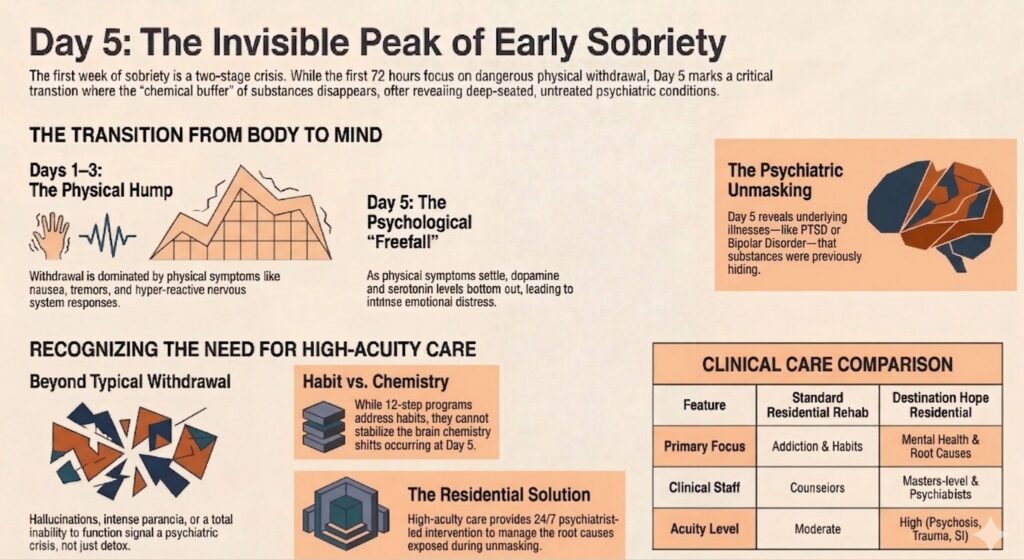
The first few days of sobriety are usually a blur of physical symptoms including sweating, nausea, and tremors. By day five, the body begins to settle, but the mind stays in a state of high alert. For many people, especially those with undiagnosed or undertreated psychiatric conditions, the early days feel like freefall. The chemical buffer is gone, and the reality of their mental health becomes undeniable.
This isn’t a lack of willpower. It is biology. According to SAMHSA, millions of adults experience co-occurring disorders where mental illness and substance use are inextricably linked. At day five, the reason behind your use starts to scream for attention. You are no longer numbing the symptoms of your primary illness, and your brain doesn’t yet have the tools to cope.
Call our team today at 954-302-4269 and verify your loved one’s insurance.
What Your Body and Mind Are Actually Going Through
Understanding the difference between your body healing and your mind struggling is the first step toward getting the right level of care.
The Physical Side: What Withdrawal Does in the First Week
Most people think detox is over in 72 hours. While the most dangerous physical risks like seizures or delirium tremens often peak early, your central nervous system remains hyper-reactive for much longer. Your brain stopped producing its own “feel-good” chemicals because it relied on outside substances for so long. Now, your dopamine and serotonin levels are bottoming out, leading to physical lethargy and a total lack of pleasure.
The Psychiatric Side: When Symptoms Go Beyond Detox
This is where the distinction matters. If you are experiencing hallucinations, intense paranoia, or a depression so heavy you cannot get out of bed, you are likely dealing with more than just withdrawal.
For our clients at Destination Hope, we often find that the substance use was a secondary symptom. The primary issue is a psychiatric condition, such as Schizoaffective Disorder or complex trauma, that has never been properly stabilized. When the substance is gone, the root cause of the pain is exposed. We call this the psychiatric unmasking. It is the moment when you realize that just stopping isn’t enough. You need psychiatrist-led care to manage the underlying illness.
A Note on Clinical Assessment: If these symptoms sound familiar, a confidential clinical assessment can help clarify whether what you are experiencing goes beyond typical early recovery. Destination Hope offers detailed psychiatric evaluations as the first step in our Tamarac facility.
What It Might Mean If Struggling Doesn’t Stop
If you are five days sober and the noise in your head is getting louder, it may mean you have a co-occurring disorder. This isn’t a new burden. It is an explanation.
Many individuals we treat in South Florida have spent years in and out of traditional rehabs that only focused on the habit. They were told to work harder or attend more meetings. But if you have a primary psychiatric illness, a 12-step meeting cannot stabilize your brain chemistry. You may be dealing with:
- Clinical Depression: A heaviness that feels physical and makes sobriety feel like a chore.
- Bipolar Disorder: Intense shifts in energy and mood that make staying level feel impossible.
- Generalized Anxiety or Panic Disorder: A constant state of fight or flight that makes every minute feel like an emergency.
- PTSD: Flashbacks or intrusive thoughts that the alcohol used to keep at bay.
For many people, the alcohol or substances were functioning as self-medication for an underlying psychiatric condition that was never properly treated. Reframing residential mental health treatment as the logical response, not a last resort, can change the trajectory of your recovery.
Is This Normal Early Recovery, or a Sign You Need More Support?
It is hard to trust your own judgment when you’re only five days in. Use the following checklist to determine if your current environment is enough to keep you safe.
The Early Sobriety Self-Check
Answer yes or no to the following:
- Are you experiencing thoughts of self-harm or that everyone would be better off without you?
- Are you hearing or seeing things that others do not?
- Have you been unable to sleep for more than 48 hours?
- Is your anxiety so intense that you are having physical panic attacks daily?
- Do you feel disconnected from reality or your own body (dissociation)?
- Have you tried outpatient therapy before and still ended up back at day one?
If you answered yes to more than two of these, you likely need a residential level of care.
Comparing Levels of Care
| Feature | Outpatient / 12-Step | Standard Residential Rehab | Destination Hope Residential |
| Medical Supervision | None | Limited / Nursing | 24/7 Psychiatric Care |
| Primary Focus | Sobriety | Addiction / Habits | Mental Health / Root Cause |
| Clinical Staff | Entry-level / Peer | Counselors | Masters-level and above |
| Acuity Level | Low | Moderate | High (Psychosis, SI, Trauma) |
| Environment | Home | Group Home | Clinical Residential |
Finding Psychiatric-Level Residential Care in South Florida
There is a gap in the healthcare system. On one side is the hospital, a sterile, 72-hour ward designed to stop a crisis but not to heal it. On the other side is the luxury rehab that focuses on amenities but lacks the clinical depth to handle a psychotic break or severe Bipolar Disorder.
Destination Hope exists in that gap. Located in Tamarac, Florida, near Fort Lauderdale, we provide a residential environment that is comfortable and dignified with the psychiatric intensity of a high-level clinical program.
We don’t just check a box for dual diagnosis. We treat the mental health condition as the primary driver. Our team consists of Masters-level clinicians and psychiatrists who understand how to establish a baseline, manage medications effectively, and deliver evidence-based therapies in a gender-specific setting. We serve the entire Broward County area and beyond, helping people who have been discharged from other programs because their mental illness was never the priority.
Frequently Asked Questions
Is it normal to feel depressed or anxious after 5 days sober?
It is common to feel some rebound anxiety, but intense, debilitating depression is often a sign of an underlying clinical issue. If the feelings make you want to give up on life, they require immediate psychiatric attention.
Why do I feel worse mentally after quitting alcohol or drugs?
Alcohol and drugs often act as a chemical lid on a pressure cooker of emotions and psychiatric symptoms. When you remove the substance, the pressure of your untreated mental health condition is released. This can make you feel worse than when you were using it.
How long does early sobriety depression last?
For typical withdrawal, it may last a few weeks. However, if it is a primary Major Depressive Disorder, it will not go away on its own. It requires a combination of medication management and intensive therapy to resolve.
What is the difference between withdrawal symptoms and a mental health crisis?
Withdrawal symptoms are usually physical, such as nausea and shakes, and subside within a week. A mental health crisis involves a loss of function. This includes suicidal ideation, psychosis, or total emotional dysregulation that does not improve as the toxins leave your body.
Can quitting drinking trigger a psychiatric episode?
Yes. The stress of withdrawal on the brain can trigger manic episodes in people with Bipolar Disorder or psychotic features in those with Schizophrenia. This is why high-acuity residential care is safer than trying to white-knuckle it at home.
What is a co-occurring disorder and how is it treated?
A co-occurring disorder, or dual diagnosis, means you have both a mental health condition and a substance use disorder. They must be treated simultaneously. At Destination Hope, we prioritize the mental health diagnosis to ensure the sobriety actually lasts.
When should someone go to residential treatment instead of outpatient care?
If you cannot stay safe at home, if your symptoms prevent you from working or eating, or if outpatient therapy hasn’t stopped the cycle of relapse, residential treatment is the next logical step. It provides the stabilization you need to finally build a foundation.
You Don’t Have to Fall Through the Floor
Whether you are five days sober and struggling, or you are watching someone you love fall apart after a hospital discharge, Destination Hope was built for this moment. We catch the people the rest of the system misses. We provide the clinical authority to handle severe mental illness and the empathy to help you through the hardest work you will ever do.
If you are in the Fort Lauderdale area or anywhere in Florida, contact us today for a confidential assessment. We can also help family members who are looking for a path forward for their loved ones. Let’s stop the freefall and start the healing.
Starting Your Road to Sobriety
Call our admissions team at 954-302-4269 to verify insurance, ask questions and begin intake for your loved one.
Destination Hope is located at 8301 W. McNab Road, Tamarac, Florida.
