


You’ve watched the therapy appointments stack up. You’ve tracked the medication changes, the dose adjustments, the switches to something new. You’ve sat with your loved one through panic attacks and sleepless nights and days where leaving the house felt impossible. You’ve done everything right, and it hasn’t been enough.
If you’re searching for anxiety help for a loved one and wondering whether residential treatment is the next step, that search itself is telling you something. Severe anxiety that hasn’t responded to outpatient care is a clinical problem that deserves a clinical answer, not another round of “let’s wait and see.”
If you’re not sure whether what you’re seeing rises to the level of residential care, a confidential conversation with the clinical team at Destination Hope can help you understand your options.
Key Takeaways
- Anxiety disorders that don’t respond to outpatient therapy and medication management may require a higher level of care.
- Residential mental health treatment offers psychiatrist-led stabilization, intensive therapy, and 24-hour clinical support that weekly outpatient appointments cannot replicate.
- Choosing residential care for a loved one with severe anxiety is not an overreaction. It is a clinically appropriate response to a condition that has become unmanageable.
- Destination Hope, located in the Fort Lauderdale area of South Florida, provides primary psychiatric residential care for adults with severe anxiety disorders and other complex mental health conditions.
- A full continuum of care, including PHP and IOP step-down options, supports lasting recovery after residential treatment ends.
When Anxiety Becomes More Than Outpatient Care Can Handle
The Difference Between Manageable Anxiety and a Psychiatric Crisis
Anxiety exists on a spectrum. At one end, there’s the ordinary tension before a hard conversation or a stressful week at work. At the other end, there’s a psychiatric condition that has dismantled someone’s ability to function.
Generalized anxiety disorder, panic disorder, social anxiety disorder, and related conditions are real illnesses with real neurological and psychological components. For many people, they respond well to outpatient treatment: a good therapist, the right medication, consistent support. For others, the illness is more severe, more treatment-resistant, or more entangled with trauma, co-occurring conditions, or biological factors that weekly therapy simply cannot reach.
The difference isn’t willpower. It isn’t an effort. It’s acuity, and acuity determines what level of care is actually appropriate.
When anxiety has reached the point where your loved one can’t work, can’t maintain relationships, can’t manage basic daily functioning, or is experiencing physical symptoms so severe they’ve required emergency medical attention, that is a psychiatric crisis. It belongs in a psychiatric setting, not on a waitlist for an outpatient slot.
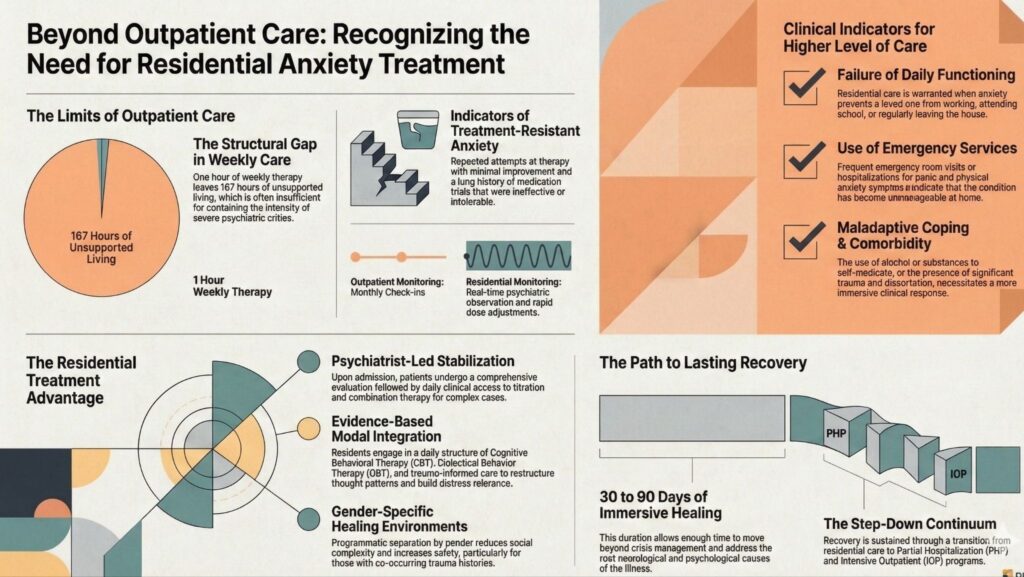
Signs That Your Loved One’s Anxiety Has Crossed a Clinical Threshold
Use this as a quick self-check. If several of these describe your loved one’s situation, residential treatment is worth a serious conversation.
- Has outpatient therapy continued for months or years without meaningful improvement?
- Has your loved one tried two or more medications without adequate relief?
- Is anxiety preventing them from working, attending school, or leaving the house regularly?
- Have there been emergency room visits or hospitalizations related to panic or anxiety symptoms?
- Is anxiety accompanied by significant depression, dissociation, or trauma-related symptoms?
- Is your loved one using alcohol or substances to manage anxiety symptoms?
- Are you, as a family member, reorganizing your own life around their anxiety to help them cope?
If you answered yes to three or more of these, what you’re describing isn’t mild anxiety that needs a better coping toolkit. It’s a condition that has become unmanageable, and it deserves treatment at the appropriate level of intensity.
Why Standard Treatment Often Falls Short for Severe Anxiety
The Limits of Weekly Therapy and Medication Management Alone
Outpatient care is built for a certain range of severity. A weekly therapy session gives someone tools to practice, space to process, and a consistent therapeutic relationship. For many people with anxiety, that’s enough.
For others, it isn’t, and that’s not a failure of the person or the therapist. It’s a structural limitation. One hour per week, with 167 hours of unsupported living in between, cannot provide the containment or intensity that severe anxiety requires. Medication management in an outpatient setting means a monthly check-in at best, with no way to closely monitor response, adjust quickly, or address the psychiatric complexity that often underlies treatment-resistant anxiety.
When anxiety is rooted in complex trauma, when it co-occurs with other mood or thought disorders, or when it has become so entrenched that the nervous system is stuck in a chronic state of activation, the standard outpatient model doesn’t have the tools to break that cycle.
What “Treatment-Resistant” Anxiety Actually Looks Like
Treatment-resistant anxiety isn’t a diagnosis. It’s a pattern: repeated attempts at appropriate treatment that haven’t produced the improvement the person’s functioning requires.
It looks like a person who has seen three therapists and found each one helpful to a point, but never past that point. Maybe it is a medication history that spans a decade, with a long list of trials that either didn’t work or couldn’t be tolerated. It looks like someone who has developed secondary problems (social isolation, substance use, depression, physical health decline) because the underlying anxiety was never adequately treated.
Family members of people with treatment-resistant anxiety often describe a particular kind of exhaustion: they know their loved one is trying, they know the outpatient providers are trying, and yet nothing changes. That exhaustion is a signal. It’s the system telling you that the current level of care isn’t matched to the clinical need.
You’ve done everything outpatient care could offer. There’s a next step, and it doesn’t have to look like a hospital.
Want to learn more? Call Destination Hope at 954-302-4269
What Residential Mental Health Treatment Offers That Outpatient Cannot
Psychiatrist-Led Stabilization and Medication Evaluation
In a residential mental health setting, the psychiatric work happens in real time. A psychiatrist isn’t reviewing a month of symptom logs during a 20-minute appointment. The clinical team is observing your loved one daily, adjusting treatment as needed, and working from a comprehensive picture of how that person is actually functioning, not just how they report feeling on a given Tuesday.
For people with severe anxiety, this matters enormously. Medication management for complex anxiety disorders often requires careful titration, combination approaches, and attention to how anxiety interacts with sleep, nutrition, trauma symptoms, and co-occurring conditions. That kind of precision is only possible in an environment where the clinical team has daily access and the ability to respond quickly.
At Destination Hope, our psychiatrist-led team provides comprehensive evaluation on admission, followed by individualized treatment planning that addresses the full clinical picture. We do not treat anxiety as a simple, standalone condition. We look at what else is present, what else has been tried, and what the neurological and psychological roots of the illness actually are.
Immersive, Evidence-Based Therapy: CBT, DBT, and Trauma-Informed Care
Residential treatment replaces one hour of therapy per week with a structured therapeutic environment where the healing work is the daily architecture of life.
Cognitive Behavioral Therapy (CBT) is among the most extensively studied treatments for anxiety disorders, with strong evidence for its effectiveness in restructuring the thought patterns that sustain anxious responses. Dialectical Behavior Therapy (DBT) builds the distress tolerance and emotional regulation skills that help people with severe anxiety manage acute symptoms and develop a different relationship with their internal experience. Trauma-informed care addresses what often lies underneath: adverse experiences, attachment disruption, and chronic stress responses that the nervous system has never been given the resources to resolve.
In a residential setting, these approaches aren’t delivered in isolation. They’re woven into a daily structure that includes individual therapy, group work, skill-building sessions, nutrition programming, and psychiatric oversight. Progress can be consolidated rather than lost between sessions.
Getting Anxiety Help for a Loved One in South Florida
What to Expect From the Admissions and Evaluation Process
Calling an admissions team when your loved one is in crisis, or when you’re not sure whether their situation qualifies, can feel like a high-stakes leap. It doesn’t have to be.
At Destination Hope, the admissions process begins with a clinical conversation, not a sales call. Our team will ask about your loved one’s history, current symptoms, previous treatment, and what hasn’t worked. The goal is honest clinical assessment: determining whether residential care is the appropriate level of care, and whether Destination Hope is the right fit for what your loved one needs.
If residential care is appropriate, we’ll walk you through what to expect: the comprehensive psychiatric evaluation at intake, the development of an individualized treatment plan, and the structure of daily life at our facility in Tamarac, in Broward County. If it isn’t the right fit, we’ll say so, and point you toward what might be.
How Gender-Specific, Residential Care Creates Conditions for Real Progress
The treatment environment shapes the treatment outcomes. Destination Hope provides gender-specific residential programming because many people with severe anxiety, particularly those with co-occurring trauma histories, make more meaningful clinical progress in a setting where they feel safe and where group therapeutic work doesn’t carry the added social complexity of a mixed-gender environment.
Residential stays of 30 to 90 days provide enough time to do real work. Not just stabilization, not just crisis management, but the deeper clinical work of understanding the root causes of anxiety, building the skills to manage it, and establishing a new baseline for functioning. Our step-down continuum, including a Partial Hospitalization Program (PHP), Intensive Outpatient Program (IOP), and extended care options, ensures that progress made in residential treatment has a foundation to build on after discharge.
Frequently Asked Questions
How do I know if my loved one’s anxiety is severe enough for residential treatment?
If outpatient therapy and medication management have not produced meaningful improvement over months or years, if anxiety is preventing your loved one from working or maintaining basic functioning, or if there have been hospitalizations or emergency interventions, the severity likely warrants a higher level of care. A clinical consultation can help you assess this directly.
What’s the difference between residential mental health treatment and a psychiatric hospital?
A psychiatric hospital focuses on acute stabilization: getting someone safe enough to discharge, typically within days. Residential treatment offers weeks or months of intensive psychiatric care, therapy, and skill-building in a dignified, structured environment. The goal is not just safety but genuine clinical progress.
Can anxiety disorders be treated in a residential setting without a substance use issue?
Yes. Destination Hope provides primary psychiatric residential care for anxiety disorders and other mental health conditions. Substance use does not need to be present. If it is present, it’s treated simultaneously as a co-occurring condition.
What does a typical day look like in a residential anxiety treatment program?
Days are structured around individual therapy, group therapy sessions, psychiatric appointments, medication management, skill-building programming, nutrition support, and unstructured time for rest and integration. For people with severe anxiety, that structure is itself therapeutic.
How long does residential treatment for severe anxiety usually last?
Stays at Destination Hope range from 30 to 90 days, depending on clinical need and progress. Length is determined by the treatment team in collaboration with the individual and their family.
Will my loved one’s insurance cover residential mental health treatment for anxiety?
Destination Hope accepts most major insurance plans. Our admissions team can conduct an insurance verification and walk you through coverage before you make any decisions.
How do I talk to someone I love about getting more intensive help for their anxiety?
Lead with what you’ve observed, not with what you think they should do. “I’ve watched how much you’re struggling, and I want to find something that actually helps” lands differently than “you need to go somewhere.” Our clinical team can also consult with families on how to approach these conversations.
What happens after residential treatment? Is there ongoing care?
Destination Hope provides a full continuum of care. Most residents step down to our PHP or IOP programs, which provide continued intensive support while transitioning back to daily life. Continuing care planning begins early in the residential stay, not at the end.
Start Your Admission Now
You don’t have to figure this out alone. If your loved one has been struggling with severe anxiety and outpatient care hasn’t been enough, call our admissions team or submit a confidential inquiry. We’ll help you understand whether residential treatment is the right fit, and what that path forward could look like.
Destination Hope
Phone: 954-302-4269
Address: 8301 W. McNab Road, Tamarac, Florida
