You’ve likely spent the last few months becoming an amateur expert on a crisis you never wanted to understand. You know the names of the medications. You know the names of the local hospital discharge planners. And you know that sinking feeling when the phone rings at 2 a.m.
Finding mental health treatment in Florida can feel like a series of dead ends. You find a hospital that stabilizes a crisis but discharges your loved one before they’re actually well. You find a rehab center that advertises “dual diagnosis” but doesn’t have a psychiatrist on-site more than once a week. If you want to break the cycle of stabilize and release, the thing to look for is residential psychiatric care that treats mental illness as the primary cause, not a secondary symptom.
Destination Hope is a licensed residential mental health treatment center in South Florida specializing in high-acuity psychiatric care.
Key Takeaways
- Florida’s Baker Act is for stabilization, not long-term healing. It keeps people safe during a 72-hour involuntary examination, but it rarely addresses the root of a psychiatric disorder.
- Traditional rehab is often the wrong fit. Programs built for addiction frequently lack the clinical depth to manage schizophrenia, bipolar disorder, or severe psychosis.
- Residential treatment is the middle ground. It offers the intensity of a hospital without the institutional coldness, with room for real medication management and therapy.
- Clinical expertise matters. Look for programs in South Florida that employ a Masters-level clinical team and are led by psychiatrists, not addiction counselors.
If you’re trying to understand what level of care your loved one actually needs, our admissions team can help you make sense of the options. No pressure, no commitment.
What Florida’s Mental Health System Gets Right and Where It Falls Short
Florida is home to some of the most specialized medical professionals in the country, yet the behavioral health system stays fragmented. Most families find themselves caught in a loop, forced to choose between a sterile hospital ward and a “luxury” rehab that amounts to a vacation with a few therapy sessions thrown in.
The Hospitalization Ceiling: Stabilized, Not Treated
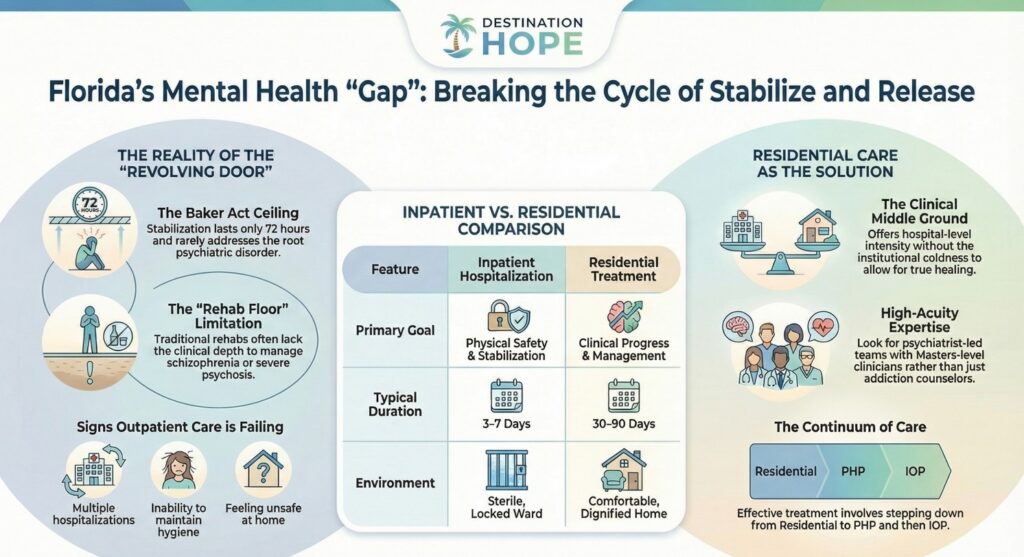
In Florida, the Baker Act is the primary tool for acute crises. According to the Florida Department of Children and Families, it allows for an involuntary examination of up to 72 hours at a designated receiving facility. The purpose is to prevent immediate harm. That’s necessary, but it isn’t treatment. A hospital’s goal is to get a patient to a baseline where they’re no longer an active threat to themselves or others. Once that box is checked, the insurance company pushes for discharge.
The result is a revolving door. Your loved one comes home with a new prescription and a list of outpatient therapists, but the underlying psychosis or depression hasn’t changed. They’re safe for the moment. They aren’t better.
The Rehab Floor: Dual Diagnosis Labels Without Psychiatric Depth
The South Florida recovery scene is crowded. Many of these facilities are built around the 12-step model for addiction. They might put “dual diagnosis” on their website, but they often struggle when a patient presents with active suicidal ideation or a complex mood disorder.
If your loved one is hearing voices or can’t get out of bed, a program focused mainly on staying sober is going to fail them. You can’t treat a substance use disorder well when the primary psychiatric condition, whether it’s schizoaffective disorder or severe PTSD, gets handled as a side project. That’s why true dual diagnosis care treats the mental illness and the substance use at the same depth, at the same time.
Signs Your Loved One Needs More Than Outpatient Care
Outpatient therapy is the right choice for many people, but it has limits. If you’re reading this, you’ve likely already seen those limits. You’ve sat through “medication management” appointments that last ten minutes. You’ve watched weekly therapy sessions that don’t seem to touch the reality of the person’s daily struggle.
When Weekly Therapy and Medication Changes Stop Working
When a person’s mental health is unmanageable, an hour of therapy a week is like trying to empty an ocean with a thimble. You might notice that your loved one is “performing” wellness for their therapist, then collapsing the moment they get home. Or maybe the medications have been adjusted five times in six months, and each change brings more side effects and less relief.
Self-Check: Is It Time for a Higher Level of Care?
Answer these questions honestly. If you say “yes” to more than three, outpatient care is likely no longer enough.
- Has your loved one been hospitalized more than once in the last year?
- Are they unable to maintain basic hygiene, nutrition, or a sleep schedule?
- Have they stopped participating in work, school, or family life entirely?
- Does their behavior leave you feeling unsafe or constantly on edge in your own home?
- Are they using substances to quiet psychiatric symptoms like hallucinations or intrusive thoughts?
- Have outpatient providers suggested they might need “more support than we can provide”?
- Is the person’s reality regularly different from yours, with delusions or paranoia?
Behaviors That Signal a Higher Level of Care
Clinicians often talk about “high acuity.” It’s shorthand for a situation that has turned serious. It means active psychosis, where a person loses touch with shared reality. It means severe mood dysregulation, where the highs and lows run so extreme they cause physical exhaustion or financial ruin. It describes a person who wants to get better but can’t find the floor beneath their feet.
If what you’re reading sounds familiar, Destination Hope was built for exactly this situation, and our residential program is where that work begins.
Understanding the Levels of Psychiatric Care in Florida
Navigating the acronyms of the mental health world is a chore. PHP, IOP, residential. It sounds like alphabet soup when you just want to know where your daughter or husband should go.
Inpatient Hospitalization vs. Residential Mental Health Treatment
This is the most common point of confusion. A hospital is for crisis. A residential program is for healing.
| Feature | Inpatient Hospitalization | Residential Treatment |
| Primary Goal | Physical safety and stabilization | Clinical progress and symptom management |
| Duration | 3 to 7 days | 30 to 90 days |
| Environment | Clinical, locked ward, sterile | Comfortable, dignified, residential |
| Therapy Frequency | Minimal, group focused | Daily, intensive individual and group |
| Psychiatric Oversight | Daily, but brief | Frequent, integrated into daily life |
PHP, IOP, and What a Full Continuum of Care Looks Like
A continuum of care is a step-down process. At Destination Hope, we don’t discharge people straight back into the world after 30 days.
- Partial Hospitalization Program (PHP): Often the first step after residential care. It involves five to six hours of clinical work a day, while the individual may begin transitioning to a supervised living environment.
- Intensive Outpatient Program (IOP): For people ready to start reintegrating into work or school who still need nine to fifteen hours of therapy a week to hold their baseline.
Finding Residential Mental Health Treatment in South Florida
If you live in Broward County or the surrounding areas, you know that a search for “Fort Lauderdale mental health” brings up a lot of results. Most of them are for addiction. To find actual psychiatric care, you have to look past the stock photos of people walking on the beach.
What to Look for in a High-Acuity Psychiatric Program
You need a team that doesn’t flinch. When you call an intake department, ask them plainly: “Do you treat schizophrenia?” or “Can you handle someone with active suicidal ideation?” If they hesitate or pivot the conversation back to alcohol or drugs, they aren’t equipped for your loved one.
Look for Joint Commission accreditation. Look for a facility licensed by the Florida Department of Children and Families and the Florida Agency for Healthcare Administration. These aren’t decorative badges. They’re proof that a facility meets rigorous clinical standards, and you can read more about ours on our accreditation page.
Questions to Ask Before Choosing a Residential Facility
- Who leads the clinical team? You want a psychiatrist-led team with Masters-level clinicians, not entry-level techs.
- What is the average length of stay? Real psychiatric stabilization usually takes 30 to 90 days. Anything shorter is often a band-aid.
- Is there on-site medical detox? Many people with severe mental illness use substances to cope. You need a facility that can safely manage withdrawal while addressing the mental health triggers underneath it.
- Is the program gender-specific? For many people working through trauma or complex mood disorders, gender-specific environments provide a level of safety that co-ed facilities can’t match.
How Destination Hope Fills the Gap
Since 2006, we’ve operated in the space no one else wants to touch. We founded Destination Hope in Tamarac, Florida, because we saw too many people falling through the floor. The gap is real. It’s the space between the 72-hour psychiatric hold and the standard rehab.
We’re a primary mental health treatment center. If your loved one has schizophrenia, bipolar disorder, or severe depression, that’s our focus. If they also have an addiction, we treat that too, and we never pretend the addiction is the only problem.
Our clinical team is built at a Masters-level floor. We use evidence-based modalities like Cognitive Behavioral Therapy and Dialectical Behavior Therapy, applied through the lens of trauma resolution. We don’t just want to change behaviors. We want to understand the “why” behind the pain. Families have their own place in that work through our family program, because the people who’ve carried this crisis need support too.
You’ve watched your loved one disappear. We’re here to help bring them back. This isn’t a place for amenities and stock photos. It’s a place for the hardest clinical work there is, done in a bright, comfortable environment that respects the dignity of the person receiving care.
Frequently Asked Questions
1. What is the difference between inpatient hospitalization and residential mental health treatment in Florida?
Inpatient hospitalization is a short-term, crisis-focused stay, usually 3 to 7 days, meant to ensure immediate safety. Residential treatment is a longer-term program, usually 30 to 90 days, focused on intensive therapy and medication management in a home-like setting.
2. How do I know if my loved one needs residential psychiatric care or outpatient therapy?
If outpatient therapy hasn’t prevented hospitalizations, or if your loved one can’t function in daily life such as working, eating, or sleeping, residential care is often what’s needed to establish a stable baseline.
3. What mental health conditions qualify for residential treatment in Florida?
We treat major depressive disorder, bipolar disorder, schizophrenia, schizoaffective disorder, PTSD, anxiety disorders, eating disorders, and personality disorders as primary conditions.
4. Does insurance cover residential mental health treatment in Florida?
Most major insurance plans do cover residential mental health treatment, though the extent of coverage varies. Our team can help you verify your benefits and understand your options.
5. What should I look for when choosing a psychiatric residential facility in Florida?
Prioritize psychiatrist-led care, Joint Commission accreditation, and a high ratio of Masters-level clinicians. Be cautious of facilities that emphasize amenities over clinical depth.
6. How long does residential mental health treatment typically last?
A typical stay ranges from 30 to 90 days, depending on the severity of symptoms and the time needed to stabilize medications and engage in deep therapeutic work.
7. Can someone with active suicidal ideation or psychosis be admitted to a residential program?
Yes. Destination Hope is designed for high-acuity patients, including those with suicidal ideation or psychotic features, provided they don’t require the immediate medical intervention of a locked hospital ward.
8. What happens after residential mental health treatment, and is there a step-down program?
Yes. We offer a full continuum of care, including PHP and IOP, so the transition back to daily life is supported and gradual.
Talk to Someone Who Has Seen This Before
You don’t have to figure this out alone. Speak with our admissions team to walk through your options and find out whether residential mental health treatment is the right next step for your loved one. Call (954) 302-4269. Destination Hope is located at 8301 W. McNab Road, Tamarac, Florida.
Crisis and Emergency Resources
If you or someone you know is in a substance use or mental health crisis, help is available now. Contact the SAMHSA National Helpline at 1-800-662-HELP (4357) for free, confidential treatment referrals 24/7. Reach the 988 Suicide and Crisis Lifeline by calling or texting 988. The Crisis Text Line is available by texting HOME to 741741. For emergencies, call 911.