For people in South Florida carrying a mental health condition, the daily pressure can build until something gives. A full residential stay may feel out of reach, and one hour of therapy a week isn’t enough to hold the line. An intensive outpatient program (IOP) for mental health sits between those two. You get several hours of clinical care during the day and sleep in your own bed at night.
Some conditions ask for more than an occasional check-in. Destination Hope runs IOP as one step in a full continuum of care, so the level of support can match where a person actually is. Here’s what an IOP involves and who it tends to help.
What Is an Intensive Outpatient Program for Mental Health?
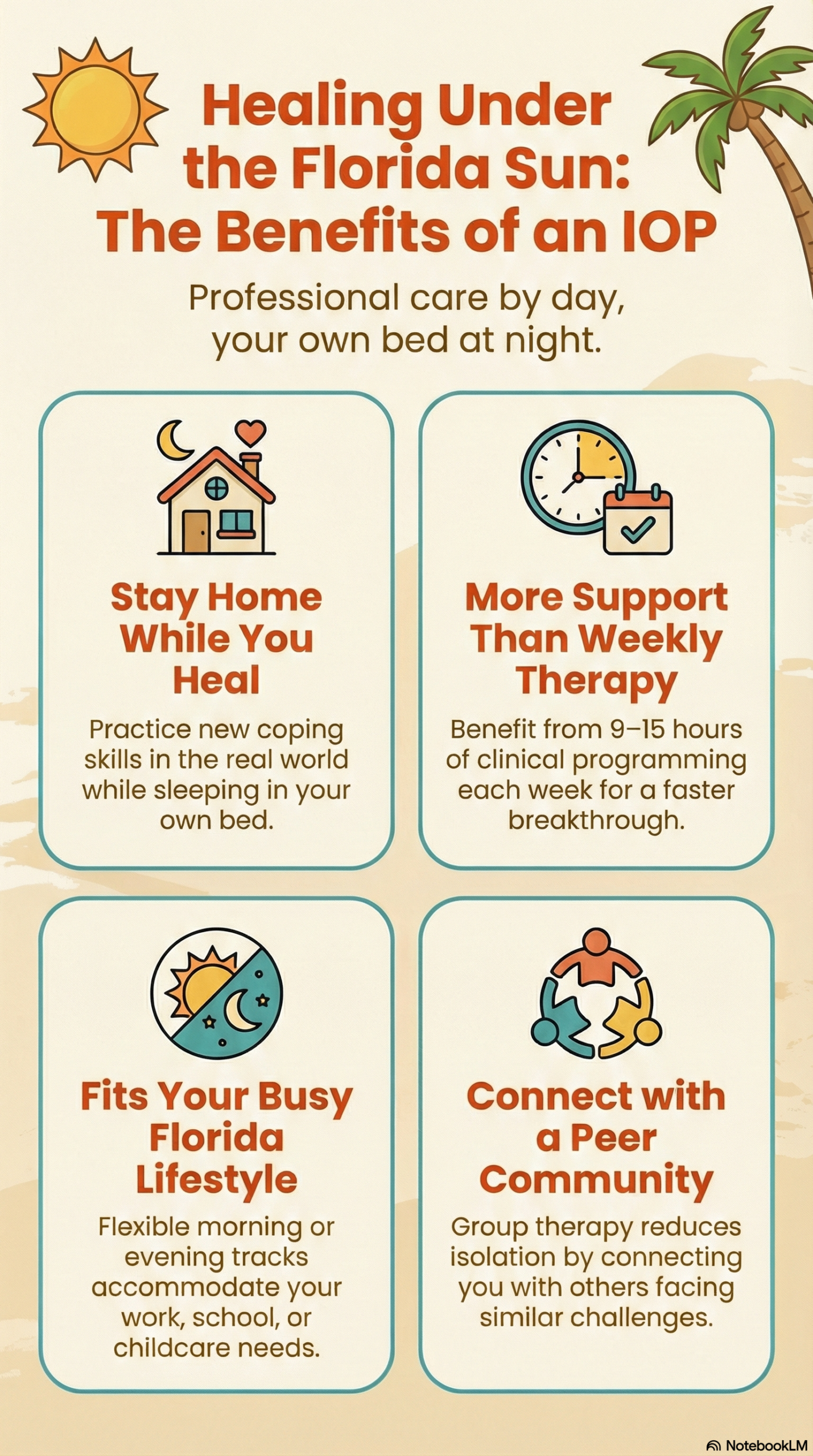
An intensive outpatient program for mental health is structured treatment for someone who is medically stable but still living with symptoms that disrupt daily life. Clients attend several hours of clinical programming across multiple days each week, then return home.
The point of that structure is to deliver evidence-based care in a setting where you can practice new skills in your real environment. You sleep at home, manage your own routine, and bring what surfaces during the week back into therapy. For many people, that makes the move toward steady, long-term function feel more durable than a program that ends abruptly at discharge.
How IOP Differs From Other Levels of Care
Traditional outpatient therapy is usually one hour of counseling a week. That’s useful for maintenance, but it often can’t generate enough momentum during a crisis. At the other end is residential treatment, where a person lives on site for 30 days or longer and receives round-the-clock care.
A partial hospitalization program (PHP) sits between residential care and IOP. PHP generally runs five days a week for roughly six hours a day, which functions like a full-time commitment. IOP asks for less time. It keeps clinical rigor while leaving room for work, school, or caring for a family, which is why it often serves as a step down from PHP or residential care.
A Typical IOP Schedule and Structure
The SAMHSA advisory on intensive outpatient treatment describes a minimum of about nine hours of structured services a week for adults, often split into three-hour sessions a few days a week. Programs commonly offer morning or evening tracks so people can keep a job or class schedule.
A session usually blends group therapy, individual counseling, and skills-focused education. The schedule stays consistent and predictable on purpose. That steadiness gives back a sense of order that often goes missing when a mental health condition takes over, and it helps people build habits that hold once the program ends.
Who Benefits From a Mental Health IOP?
IOP tends to fit people who have a stable, supportive home but still need professional structure during the week. It often helps someone stepping down from a hospital stay who isn’t ready to return to weekly therapy alone. It also works well when a mental health condition has started to bleed into job performance or coursework.
For people who want to get better but feel daunted by the idea of doing it on their own, an IOP offers a group of peers facing similar struggles. That shared experience cuts through the isolation that so often comes with a mental illness, and the clinical guidance gives the work direction.
Conditions Treated in Intensive Outpatient Programs
An IOP can address a broad range of psychiatric conditions. Common ones include:
- Major depressive disorder. Building tools to manage persistent low mood and loss of motivation.
- Anxiety disorders. Working through panic, social anxiety, and chronic worry.
- Post-traumatic stress disorder (PTSD). Trauma-informed care to process past events safely.
- Bipolar disorder. Mood stabilization and learning to catch early signs of mania or depression.
- Co-occurring disorders. Treating a mental health condition and a substance use disorder at the same time, which tends to produce better outcomes than treating either alone.
At Destination Hope, the mental health condition stays the focus of care. When substance use is in the picture, our dual diagnosis treatment addresses both together rather than treating one as an afterthought.
Signs You Might Need IOP Instead of Weekly Therapy
If you’re already in therapy but feel like you’re treading water, a higher level of care may be worth considering. Signs that an IOP could be the better fit include:
- Persistent distress. You’re in emotional crisis more days than not, and one hour a week doesn’t touch it.
- Trouble with daily tasks. Hygiene, household responsibilities, or work have become hard to keep up with.
- Growing isolation. You’re pulling away from friends and family because the symptoms feel too heavy to talk about.
- Safety concerns. You aren’t in immediate danger, but intrusive thoughts have become hard to manage alone.
- Self-medicating. You’ve started using alcohol or other substances to cope with how you feel.
If you aren’t sure whether IOP is right, our clinical team can walk through your options during a free, confidential assessment.
What to Expect in a Mental Health IOP
An IOP starts with a comprehensive clinical assessment. The team reviews your history, identifies your current triggers, and sets goals for treatment. That evaluation shapes the plan rather than slotting you into a generic track.
You can expect a professional, welcoming setting where your privacy is protected. The work goes past talking through problems. It’s about learning concrete skills you can use the same day you learn them.
Therapeutic Approaches Used in IOP
A strong IOP relies on therapies with research behind them. Common approaches include:
- Cognitive behavioral therapy (CBT). Identifying and changing the thought patterns that drive distressing emotions.
- Dialectical behavior therapy (DBT). Mindfulness, distress tolerance, and interpersonal skills for managing intense emotions.
- Trauma-informed care. Keeping the environment safe so that interventions don’t re-traumatize the client.
- Psychoeducation. Teaching the biology and psychology of a condition so clients can take an informed role in their own care.
- Relapse prevention. Spotting triggers and building a plan to stay well after the program ends.
Group Therapy and Individual Sessions
Group therapy is the backbone of most IOPs. Group sessions let people learn from one another and see common problems from new angles, and a clinician always facilitates so the conversation stays productive and safe.
Individual sessions make room for the private, deeper work that doesn’t belong in a group. The two formats balance each other. You get personal attention alongside the support of a recovery-focused community.
Finding the Right IOP in South Florida
South Florida has no shortage of behavioral health programs, and they vary widely in quality. When you’re searching for an outpatient mental health program in the Miami area, look past the website photos. You want a program that’s licensed, accredited, and staffed by clinicians who treat severe mental illness as the primary condition.
Destination Hope serves the greater South Florida region, including families coming from Miami-Dade, from our location in Broward County. We offer gender-specific care that accounts for the different ways men and women experience mental illness, and our mental health treatment programs are built around psychiatrist-led, clinician-delivered care.
Questions to Ask When Choosing a Program
Before you commit, it’s fair to interview a facility. Worthwhile questions include:
- Is the program accredited by The Joint Commission? That accreditation signals the facility meets rigorous safety and quality standards. Destination Hope has held it since 2006.
- What is the staff-to-client ratio? Smaller groups usually mean more individual attention.
- Do you offer gender-specific tracks? For many people, a single-gender group makes it easier to be vulnerable.
- How do you handle co-occurring disorders? If substance use is also present, you need a program equipped to treat both at once.
- How long does the program run? Every case differs, though many mental health IOPs last roughly eight to twelve weeks.
Insurance and Cost Considerations
Cost is one of the first worries families raise. Many private plans cover intensive outpatient care as part of their behavioral health benefits. Under the Mental Health Parity and Addiction Equity Act, a plan that covers mental health and substance use care can’t apply tighter limits to those benefits than it applies to medical and surgical care. The law doesn’t force a plan to cover mental health, but when it does, the coverage has to be on par with the rest.
Our team can help you make sense of your benefits. We work with many major insurers, and we’ll verify your coverage and lay out any out-of-pocket costs before you start. You can review your options on our insurance and payment page to begin.
Aftercare and Ongoing Support
The work you do in an IOP is a beginning, not a finish line. A strong program includes discharge planning so you have support in place when the program ends. That might mean a referral to a local therapist, a connection to a support group, or a plan to keep medication management going.
Florida has resources that can help you hold your progress:
- 988 Suicide & Crisis Lifeline. Free, confidential support, available 24/7.
- NAMI Florida. The state chapter of the National Alliance on Mental Illness runs education and support groups across South Florida.
- Florida 211. A free service that connects residents to local health and human services.
Why Families Choose Destination Hope
Destination Hope is a residential mental health facility that treats psychiatric conditions as the primary diagnosis, with dual diagnosis care when substance use is also present. The clinical team is built at a Masters level and above, led by psychiatrists, and the program is Joint Commission accredited and licensed by Florida’s Department of Children and Families and its Agency for Healthcare Administration.
Our gender-specific tracks let men and women do focused work in groups where it’s easier to open up. Because we run a full continuum from residential care through PHP, IOP, and aftercare, you can step down through the levels at a pace that matches your recovery instead of being handed off at the first sign of stability.
Taking the Next Step
You don’t have to manage this alone, and neither does the person you’re worried about. An IOP at Destination Hope gives you structured mental health support while you stay connected to home, work, and the people who matter. If you’re ready to talk through whether it’s the right level of care, our admissions team can answer your questions and start an assessment. Call (954) 302-4269.
Crisis and Emergency Resources
If you or someone you know is in a substance use or mental health crisis, help is available now. Contact the SAMHSA National Helpline at 1-800-662-HELP (4357) for free, confidential treatment referrals 24/7. Reach the 988 Suicide and Crisis Lifeline by calling or texting 988. The Crisis Text Line is available by texting HOME to 741741. For emergencies, call 911.